

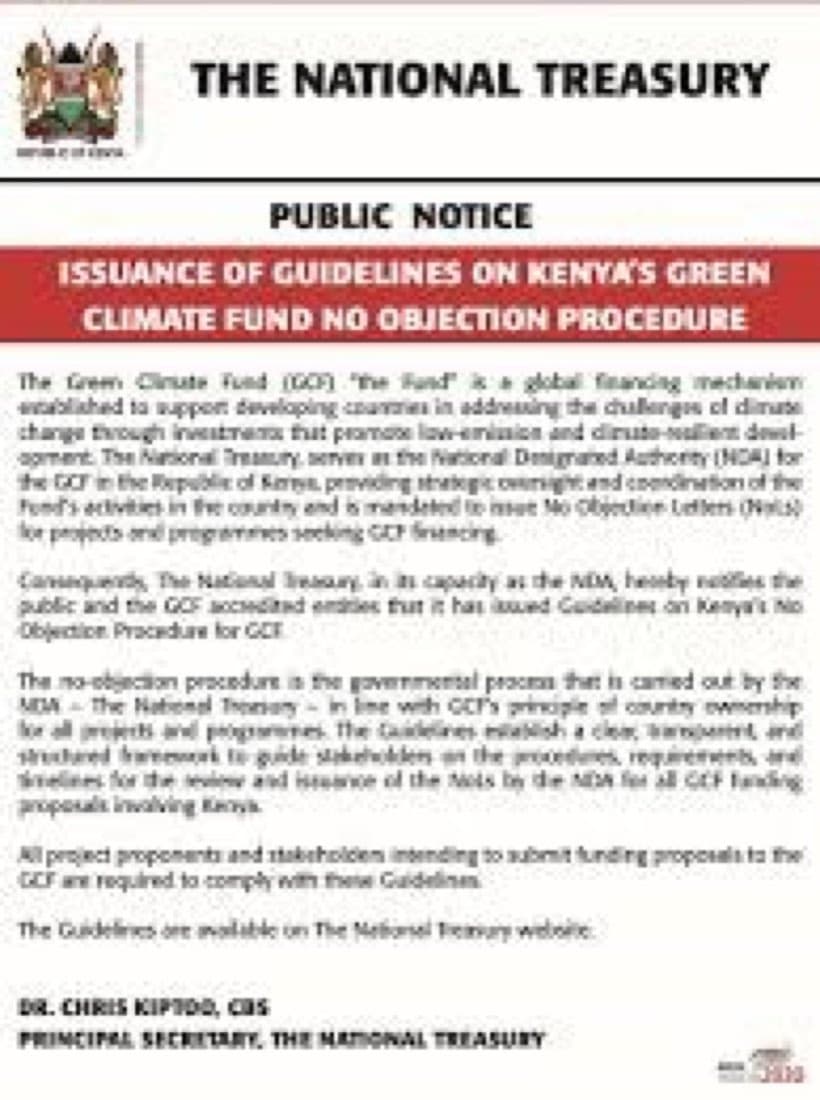
GUIDELINES ON THE NO OBJECTION PROCEDURE
UNDERSTANDING GUIDELINES ON KENYA’S GREEN CLIMATE FUND NO-OBJECTION PROCEDURE
The concept of “guidelines on Kenya’s Green Climate Fund (GCF) No Objection Procedure” refers to a structured national process through which the Government of Kenya reviews, approves, and formally endorses climate finance proposals before they are submitted to the global Green Climate Fund. At its core, this procedure is not merely administrative; it is a governance tool that ensures that all climate projects funded under the GCF framework are aligned with Kenya’s national interests, policies, and development priorities.

Conceptual Overview of the No-Objection Procedure
The no-objection procedure originates from the GCF’s global governance system, where it is defined as a mandatory requirement for all funding proposals. According to official GCF policy, a No Objection Letter (NOL) issued by a country’s National Designated Authority (NDA) must accompany every funding proposal submitted to the Fund. This requirement ensures that the proposal reflects a country-driven approach, meaning it is rooted in national priorities rather than externally imposed agendas.
In Kenya, this process is led by the National Treasury acting as the NDA. The guidelines governing this procedure outline how proposals are screened, consulted upon, and endorsed before they proceed to the GCF Secretariat. The existence of these guidelines reflects a broader principle within international climate finance: that developing countries should retain ownership over how climate funds are accessed and utilized.
Purpose and Legal-Policy Significance
At a deeper level, the guidelines on the no-objection procedure serve several interrelated purposes. First, they ensure alignment with national climate strategies and development plans. The GCF itself states that the purpose of the procedure is to guarantee consistency with national policies and to uphold country ownership. In Kenya’s case, this includes alignment with national climate change frameworks, development blueprints, and sectoral strategies.
Second, the guidelines act as a quality control mechanism. Before any project reaches the international funding stage, it must pass through national scrutiny, where technical, environmental, social, and financial considerations are assessed. This prevents poorly designed or misaligned projects from advancing.
Third, the procedure provides a formal expression of sovereign consent. By issuing a No Objection Letter, the Kenyan government is effectively stating that it supports the project and is willing to have it implemented within its jurisdiction. Without this endorsement, the GCF will not process the proposal.
Finally, the guidelines embed accountability and transparency into the funding process. They require documentation, consultations, and institutional coordination, ensuring that decisions are not arbitrary but based on established criteria and processes.
Institutional Roles and Coordination in Kenya
The implementation of the no-objection procedure in Kenya involves several actors, but the central authority is the National Designated Authority. This office coordinates all interactions between Kenya and the GCF and is responsible for issuing the No Objection Letter.
However, the NDA does not act in isolation. The guidelines typically establish an inter-institutional coordination mechanism, bringing together ministries, regulatory bodies, and technical agencies. This ensures that proposals are reviewed from multiple perspectives, including environmental compliance, financial viability, and sectoral relevance.
Kenya has also emphasized stakeholder engagement in developing its operational manual for the GCF, including the establishment of communication mechanisms and consultation processes. This reflects the understanding that climate projects often affect multiple stakeholders, including local communities, civil society, and private sector actors.
In practice, this means that a project proposal must pass through several layers of review before it receives a no-objection. These layers are designed to ensure that the project is not only technically sound but also socially acceptable and environmentally responsible.
Procedural Flow and Key Steps
The guidelines on the no-objection procedure define a sequence of steps that proposals must follow. While the exact details may vary, the general structure is consistent with global GCF requirements.
The process begins with the development of a concept note or project proposal, usually by an accredited entity or implementing partner. This proposal is then submitted to the NDA for review. At this stage, the NDA assesses whether the proposal aligns with national priorities and whether it meets the GCF’s investment criteria.
Following this initial screening, the guidelines typically require stakeholder consultations. These consultations are essential for demonstrating that the project has local support and that potential environmental and social impacts have been considered. Evidence of such engagement is often a prerequisite for approval.
The NDA may then request revisions or additional information from the applicant. This iterative process ensures that the proposal meets all necessary standards before moving forward. Once the NDA is satisfied, it issues the No Objection Letter, which must be submitted alongside the proposal to the GCF Secretariat.
Importantly, the no-objection procedure is not a one-time event but part of a broader lifecycle of project development, including monitoring and evaluation after approval.
Criteria for Approval
The guidelines specify a set of criteria that proposals must meet to receive a no-objection. These criteria are both substantive and procedural.
Substantively, the proposal must demonstrate alignment with national climate strategies, contribute to climate mitigation or adaptation goals, and deliver tangible benefits to communities. It must also comply with environmental and social safeguards, ensuring that it does not cause harm.
Procedurally, the proposal must follow the required steps, including stakeholder consultations and documentation. The GCF emphasizes that proposals must show evidence of country ownership and stakeholder buy-in.
Additionally, proposals must meet the GCF’s broader investment criteria, including impact potential, paradigm shift potential, sustainable development benefits, and efficiency. These criteria ensure that funded projects deliver meaningful and lasting outcomes.

Strategic Importance for Kenya
The guidelines on the no-objection procedure are particularly important for Kenya because they determine how the country accesses and utilizes international climate finance. By controlling the entry point for GCF proposals, the government can ensure that funding is directed toward national priorities rather than fragmented or externally driven initiatives.
This is especially relevant in sectors such as renewable energy, climate-resilient agriculture, and ecosystem conservation, where GCF funding can play a transformative role. The no-objection procedure ensures that these investments are coherent, strategic, and aligned with long-term development goals.
Moreover, the procedure strengthens Kenya’s institutional capacity by fostering coordination among agencies and promoting best practices in project design and implementation. It also enhances the country’s credibility with international partners by demonstrating a robust and transparent governance framework.
Challenges and Evolving Nature of the Guidelines
Despite its importance, the no-objection procedure is not without challenges. One common issue is the potential for delays due to the multiple layers of review and consultation. While these steps are necessary for quality assurance, they can slow down project development.
There are also concerns about balancing efficiency with inclusivity. Ensuring meaningful stakeholder engagement requires time and resources, and there is always a risk that consultations may be superficial rather than substantive.
At the global level, the GCF continues to refine the no-objection procedure to address such challenges. Recent updates emphasize standardization, improved templates, and clearer requirements for No Objection Letters. Kenya’s guidelines are expected to evolve in line with these developments, incorporating best practices and lessons learned.
Conclusion:
In summary, the guidelines on Kenya’s Green Climate Fund No Objection Procedure represent a critical framework for managing access to international climate finance. They define how project proposals are reviewed, endorsed, and aligned with national priorities before being submitted to the GCF.
These guidelines ensure country ownership, enhance accountability, and promote high-quality project design. They also reflect Kenya’s broader commitment to integrating climate finance into its development agenda in a structured and strategic manner.
Ultimately, the no-objection procedure is more than a technical requirement; it is a mechanism through which Kenya exercises control over its climate future, ensuring that external funding supports national goals and delivers real benefits to its people and environment.
USEFUL LINKS:
https://nema.go.ke/nieae-kenya/engaging-with-green-climate-fund