

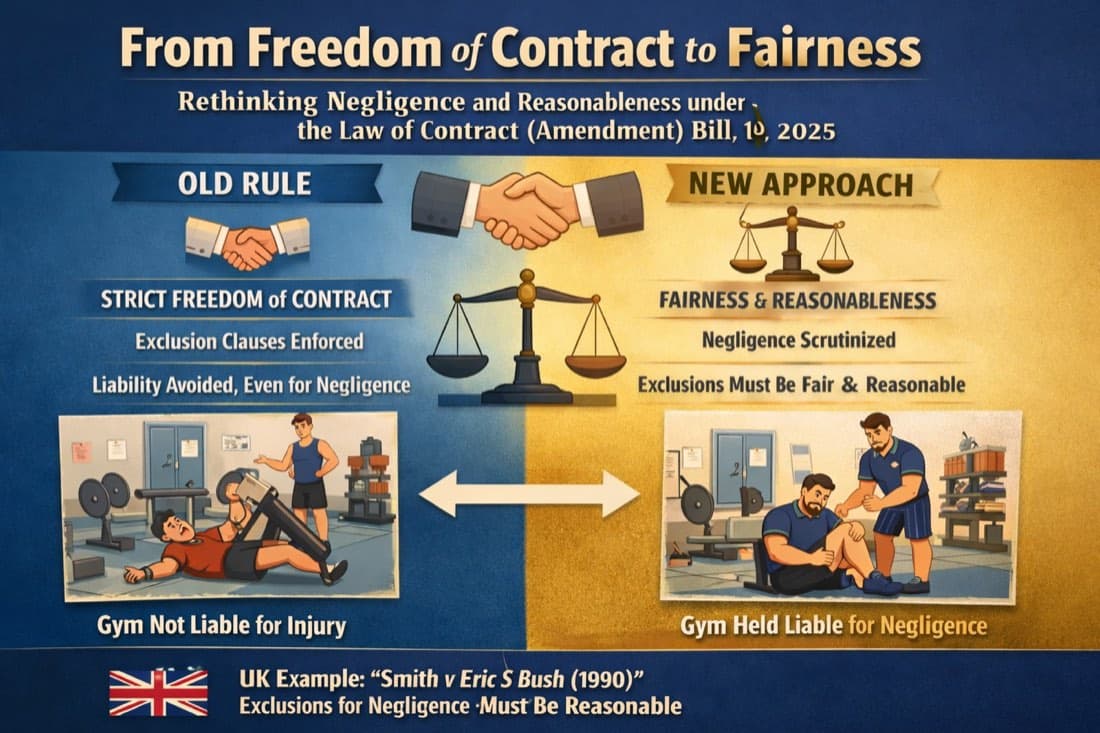
The Law of Contract (Amendment) Bill, 2025 represents a significant shift in Kenyan contract law, particularly in how negligence and reasonableness are conceptualized and applied. Traditionally, Kenyan contract law rooted in English common law placed heavy emphasis on freedom of contract, allowing parties wide latitude to allocate risks, including through exclusion and limitation clauses. This often meant that even clearly negligent parties could escape liability where contracts expressly permitted it.
The Bill departs from this classical approach by redefining negligence within a contractual framework. Under the proposed section 2A, negligence is no longer confined to tortious liability but is expressly recognized as a breach of a contractual obligation to exercise reasonable care or skill. This is a notable evolution, as it blurs the rigid boundary between contract and tort, aligning the law more closely with modern commercial realities where duties of care are often embedded within contractual performance.
More importantly, the Bill introduces the “requirement of reasonableness” as a controlling standard. This marks a clear move away from the traditional formalist view where the mere existence of consent validated contractual terms towards a substantive fairness inquiry. Courts are now invited to assess whether a term is fair and reasonable considering the circumstances known (or that ought to have been known) at the time of contracting. This introduces an objective and contextual test, limiting the enforceability of oppressive or one-sided clauses.
In relation to negligence, the Bill adopts a protective stance. It outright prohibits exclusion of liability for death resulting from negligence and subjects any limitation of liability for other loss or damage to the test of reasonableness. This is a clear rejection of the older laissez-faire position, where such exclusions could stand if clearly drafted. Additionally, the Bill clarifies that mere agreement to an exclusion clause does not amount to voluntary assumption of risk, further weakening the traditional reliance on consent as a shield.
For example, imagine a gym includes a clause in its membership contract stating: “The gym shall not be liable for any injury suffered on its premises, however caused.” A member is later injured because a trainer negligently sets up faulty equipment. Traditionally, under strict freedom of contract, the gym could rely on that clause to escape liability, arguing that the member agreed to it. Under the Bill, however, the outcome changes. The injury arises from negligence, that is, a failure to exercise reasonable care. The exclusion clause would only be valid if it satisfies the requirement of reasonableness, and a court would likely find it unreasonable to allow a service provider to completely exclude liability for its own negligence, particularly where safety is concerned. As a result, the clause would be ineffective, and the gym would remain liable.
This approach is not entirely novel; courts in the United Kingdom, particularly in Goodlife Foods Ltd v Hall Fire Protection Ltd 2018, a similar position was upheld where exclusion clauses for negligence are subject to a test of reasonableness, reflecting a shift from strict freedom of contract to substantive fairness.
Overall, the Bill reflects a broader jurisprudential shift from absolute contractual autonomy to regulated fairness, and from strict consent to contextual justice. By embedding negligence within contract and subjecting exclusion clauses to reasonableness, Kenyan law is moving toward a more balanced framework that protects weaker parties while still preserving commercial certainty.